GSWE logoGSWEBook a meeting
Menu

AMR fleet control and warehouse control software in Texas

Most warehouses that adopt autonomous mobile robots end up with a different console for every robot brand, and none of them talk to the WMS, the doors or each other. We design and write the warehouse control system that sits above them all. Parts come off the truck, go into storage and reach the line on demand, with every robot, conveyor and gate working from the same plan. We built this system for a Tier 1 automotive parts manufacturer, and we can build it for your plant.

What we build

  • Multi-vendor fleet manager

    One dispatcher for AMRs, autonomous forklifts and tuggers from different manufacturers, each connected through its own adapter to the vendor's traffic manager.

  • WMS, MES and ERP integration

    Missions start from real demand: SAP, MES and WMS orders become put-away, replenishment and line-delivery jobs automatically.

  • Traffic, zones and localization

    Geofencing, BLE and Wi-Fi localization, and asset tracking keep robots, carts and people where they belong.

  • Facility integration

    Robots open gates, call elevators, hand off to conveyors and stop safely when the fire alarm sounds.

  • Live operations dashboard

    Every robot, mission and storage location updates in real time, with alerts when a mission stalls or a battery runs low.

  • Auto replenishment and maintenance

    Line-side stock is refilled before it runs out, and preventive maintenance is scheduled from actual robot hours.

From the truck to the line

One system follows every part from the receiving dock to the workstation that uses it, without a forklift driver or a paper pick list.

  1. Receive

    A pallet comes off the semi truck. It's scanned at the dock and registered in the WMS with its part numbers and quantities.

  2. Put away

    The control system picks a storage location and sends the nearest free robot, of any brand, to move the pallet there.

  3. Store

    Inventory is tracked by location in real time, so the system always knows what is on hand and where it is.

  4. Retrieve on demand

    A line call or MES order triggers a mission. The right parts are pulled from storage the moment they're needed.

  5. Deliver to the line

    A robot drops the parts at the point of use, confirms the delivery and takes the empty container back.

How the system fits together

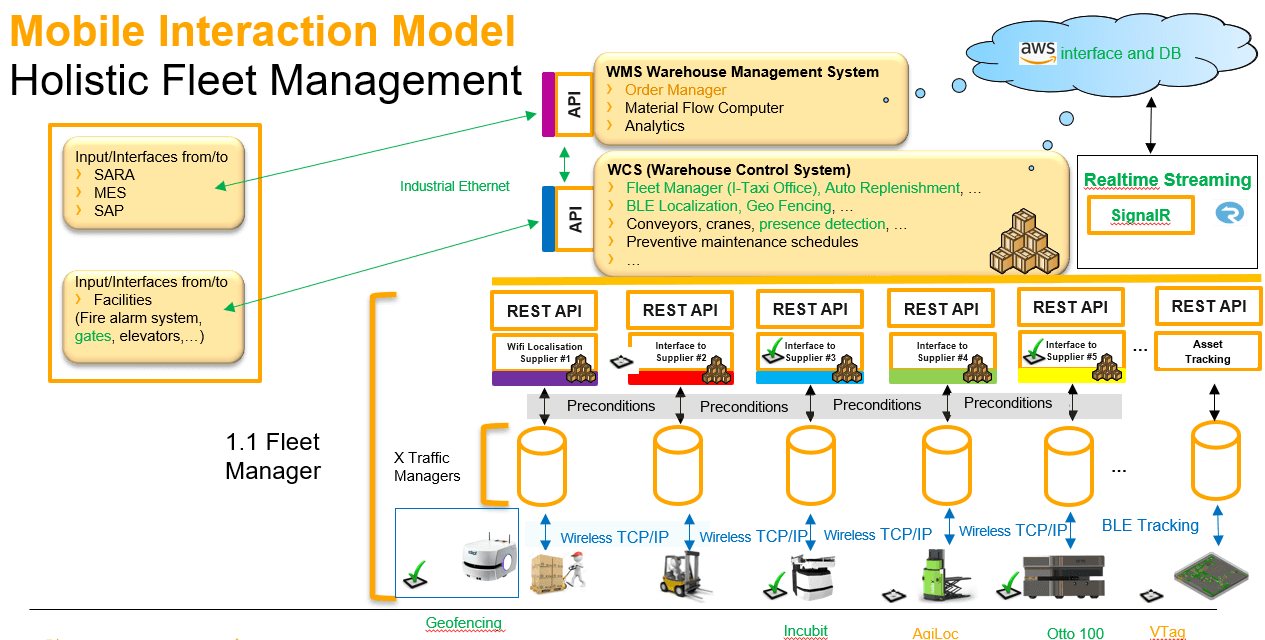
The warehouse control system sits between your business systems and the robots, so each side only has to speak one language.

AMR fleet control system architectureERP, MES and WMS send orders to the warehouse control system. The warehouse control system runs the fleet manager, mission dispatch, replenishment, geofencing, localization and maintenance, connects to gates, fire alarms, elevators and conveyors, and streams live status to a dashboard. Below it, a REST adapter for each robot vendor talks to that vendor's traffic manager, which controls its robots over wireless TCP/IP. BLE tags are tracked through a BLE gateway.ERP / SAPOrders and materialsMESLine calls and productionWMSInventory and locationsWarehouse control systemWritten by GSWEFleet managerMission dispatchAuto replenishmentGeofencingBLE and Wi-Fi localizationPreventive maintenanceLive dashboardReal-time streaming, cloudFacilitiesGatesFire alarmsElevatorsConveyorsREST adapterVendor ATraffic mgrAMRsREST adapterVendor BTraffic mgrAutonomous forkliftsREST adapterVendor CTraffic mgrTuggersREST adapterVendor DTraffic mgrPallet moversREST adapterAsset trackingBLE gatewayBLE tagsWireless TCP/IPAdd a vendor+ New adapter
Every robot vendor plugs in through its own adapter, so the warehouse control system, your WMS and your floor processes stay the same as the fleet grows.

Related work

  • Tier 1 automotive parts manufacturer

    One control system for a multi-vendor AMR fleet

    A warehouse control system, designed and written by GSWE, that runs autonomous mobile robots from several manufacturers, moving parts from the receiving dock to storage and on to the production line.

Related products

AMR fleet control system

AMR

AMR fleet control system

One warehouse control system for autonomous mobile robots from any manufacturer, from the receiving dock to the line.

Priced per site

Questions we hear often

Which robot brands can it control?
Any robot or autonomous forklift with a vendor API or traffic manager. Each manufacturer gets its own adapter behind a common interface, so adding a new brand doesn't change the rest of the system.
Does it replace our WMS?
No. Your WMS keeps managing orders and inventory. The warehouse control system sits between the WMS and the robots, turning orders into robot missions and reporting back when they're done.
How does it handle safety?
The system connects to fire alarms, gates and elevators. Robots are kept out of geofenced zones and stop or clear the way automatically when an alarm sounds.
Does it run on site or in the cloud?
Either. The control system can run on your own servers next to the robots, with optional cloud storage and analytics on AWS.
How long does a rollout take?
It depends on the number of robot vendors and systems to connect. We usually start with one flow, such as dock to storage, prove it on the floor, then add the rest.

Also from GSWE: custom websites, vision ai, data analysis and 3d printing.

Let's talk about your amr fleet control project

Tell us what you’re working on. We reply within one business day.

Or write to timgr@gswe.net